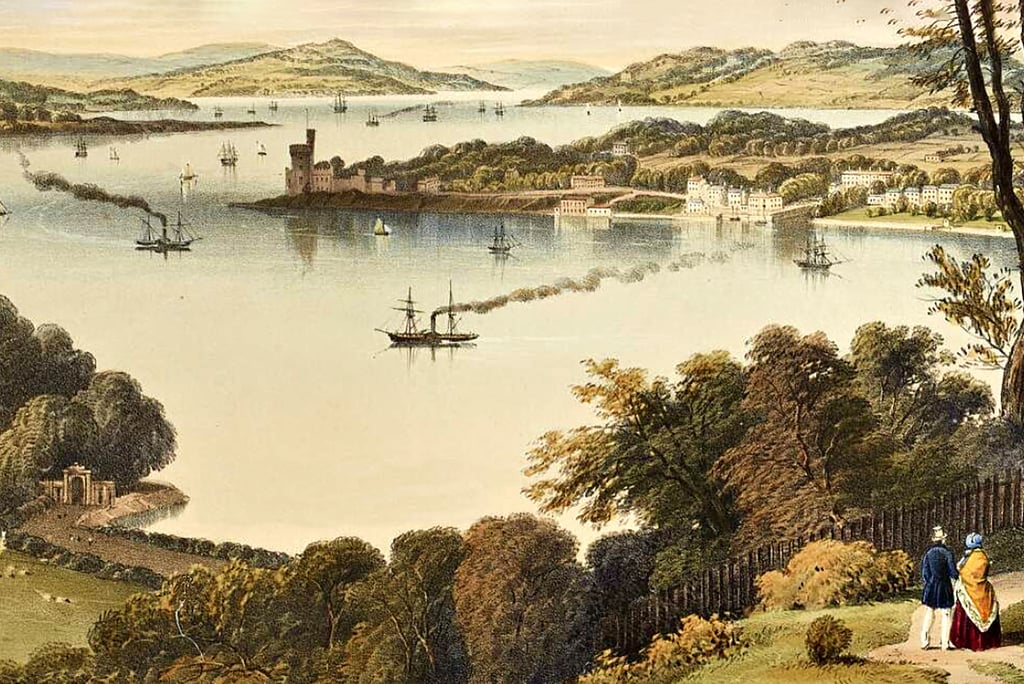
Cork Harbour, in the 19th century, was a high-tech laboratory for the burgeoning steam industry. Because the city of Cork was located several miles up the narrow River Lee, steam power became the means that allowed for reliable, scheduled transport regardless of the wind.
Long before the Cork, Blackrock and Passage railway dominated, the harbour was alive with a fleet of Paddle Steamers. These were the primary mode of transport for commuters and day-trippers. The steamers ran from St. Patrick’s Quay in the city down to Passage West, Monkstown, Glenbrook, and Queenstown (now Cobh). They were known for their distinct "clatter" and the huge plumes of black smoke. For the wealthy merchants of Cork, these ships were their "water taxis" to their summer villas in the lower harbour.
Famous Vessels: Names like the City of Cork, the Albert, and the Nelson were household names.
The City of Cork Steam Packet Company, established in the 1820s, became the backbone of Cork’s maritime economy. They didn't just move people; they were an intrinsic part of both the butter trade and the livestock trade. The ships were specifically designed to carry cattle, pigs, and the famous Cork butter to Bristol, Liverpool, and London.
As technology evolved at the Passage West and Rushbrooke docks, you could see the physical transformation of the ships.
Early Steamers (1820s-1850s)
Propulsion - Large side-mounted paddle wheels
Later Steamers (1860s+)
Rear-mounted Screw Propellers. The hull material was primarily wood and iron, then steel.
The Great Liners
The "Age of the Giants"
By the late 1800s and early 1900s, Cork Harbour (Queenstown) became the final port of call for the most famous steamships in history. While these weren't "Cork ships" per se, they defined the harbour's atmosphere.
The White Star & Cunard Lines: Ships like the Olympic, the Mauretania, and most infamously, the RMS Titanic, used the harbour as their last stop before the open ocean.
The Tenders: Because these giants were too large for the quays, local Cork-based steam "tenders" (like the PS America and PS Ireland) would ferry passengers and mail from the Cobh deep-water quay out to the liners anchored at Rochester Point.
The era of the great steamships eventually faded with the rise of the internal combustion engine and air travel, but the limestone quays of Cork Harbour still bear the marks of the heavy chains and bollards that once held these smoke-belching giants in place.
To understand the steamships of Cork Harbour, you have to look at them as "mechanical beasts" that carried the weight of human hope and desperation. The engineering wasn't just about speed; it was the very thing that transformed a death-defying two-month sail into a predictable two-week commute. Early steam engineering in Cork was a battle against the sea and salt. The transition from the 1830s to the 1900s saw a massive leap in how power was generated and used.
The SS Sirius used a Side-Lever Engine. Imagine a giant rocking horse made of iron. Because early boilers were top-heavy, the heavy machinery was placed as low as possible in the hull to keep the ship stable. These early engines were incredibly inefficient. They burned through coal so fast that ships often ran out mid-Atlantic (hence the Sirius burning its own furniture!).
You can't talk about Cork steamships without starting with the SS Sirius. In 1838, under the command of Captain Richard Roberts (a Passage West native), the Sirius became the first vessel to cross the Atlantic from East to West entirely under steam power. The ship was actually quite small for the journey, and legend has it they had to burn cabin furniture and spare yards to keep the boilers going as they neared New York, arriving just hours before the much larger Great Western. It proved that transatlantic steam travel was commercially viable, turning Cork into a primary "gateway" to the New World.
The Social History: Hope, Heartbreak, and Class
The social fabric of Cork Harbour was torn and re-sewn by these ships. The harbour wasn't just a place of work; it was a place of "The Last Goodbye." For the millions of Irish emigrants leaving through Queenstown (Cobh), the arrival of a steamship was bittersweet.
Emigrants were treated by their families as if they were dying, because they would likely never be seen again. The steam tenders (smaller boats like the PS America) would ferry these families from the pier to the giant liners. The sound of the steam whistle was often described in local lore as a mournful "wail" that signaled the final separation. The steamship didn't just carry people; it carried the future. To the person in steerage, the engine's vibration was the heartbeat of a new life in America. While wealthy passengers in the grand saloon enjoyed mahogany panels and velvet, the lives of those in the ship's bowels was much darker. The stokers, known as the "Black Gang," were men who worked in 100°F+ temperatures, shovelling tons of coal into the furnaces. In Cork, being a "Coal Heaver" was a gruelling but vital job. The local economy in Passage West and Cobh relied entirely on the physical strength of these men to keep the "beasts" fed.
A Further History of the Steamboat Services of Cork Harbour 1815- 1932.
Cork Harbour was the birthplace of inshore steamship services in Ireland. The Cork harbour service was also the longest-lived of all such services in Ireland, continuing without interruption until 1925. Thereafter, excursions continued to be run by the ocean liner tenders and other small craft stationed in the harbour.
In the early days the steamers were the property of individual owners. From 1815, when the steamers were first introduced, to the period when the Citizens River Steamers Co., was formed they operated in this fashion. The River steamers, as they were called, provided five or six sailings on week-days between Cork and Cobh. Several of these sailings were extended to Aghada. The fare to Cork in those early years was 1 shilling and 8 pence. In later years the fare dropped dramatically for a variety of reasons, which will be detailed later.
The various happenings on these boats, throughout the years makes for interesting reading. The first such boat, The City of Cork, was the first steamer ever built in Ireland. She was launched at Hennessey's Boat Yard, Passage, on 10 June 1815 and later that year began to ply between Cobh and Cork. She had a wooden hull 86 ft long and was powered by a 12 H.P. Bolton and Watt engine which gave her a speed of 6V2 knots. As she became older she became so decrepit that she was once stopped by a shoal of jelly fish. In her prime a club atmosphere prevailed on board, the latest London papers were provided in her saloon and sea-water baths was available for her passengers.
Then came the Waterloo, also built in Passage, in 1816. She was about the same size as her consort, the City of Cork. Her engine, built by James Atkinson at the Hives Iron Works in Cork, was probably the first marine engine to be built in Ireland. This vessel ended its career as a passenger carrier in 1850, converted to a lighter and broken up in 1865.
The Princess Charlotte was built on the Clyde and began service in Cork in 1820. On one occasion an illicit still was found in action in her engine room. The Lee, built in London in 1825, arrived in the early 1830's. Like the City of Cork she too had salt water baths on board. She remained for ten years in Ireland and foundered off New Quay in Cornwall, on her way back to England in 1840.
Paddle Steamers (P.S.)
The P.S. Air and the P.S. Eagle were the first of many tugs to be stationed in Cork Harbour. The Air was often used for excursion work in the mid-1830's, making weekend trips both to Youghal and Glengariff. The Eagle, on the other hand, was the first iron steamer to be registered in Cork. It was brought into service in 1838 and operated here until scrapped in 1851.
During the late 1830's and the early 1840's four further steamers arrived. These were the P.S. Queen, P.S. Maid of Erin, P.S. Prince, and the P.S. Princess. Both the latter two, the Prince and the Princess, were famous for the figureheads on their respective Bowsprits. In the case of the Prince that was a man on horse-back while the Princess carried the head and shoulders of a lady.
The Citizen River Steamers Company
By this time passenger services within the harbour were obviously very profitable. Ireland's pre-famine population had grown to eight million people and the winds of competition were beginning to blow.
The change to company ownership came in the early 1840's. The Clyde shipbuilders Tod and McGregor sent some paddle steamers to Cobh and these ultimately formed the nucleus of the Citizen's River Steamers Co. This company lasted from 1844 to 1890 and in its lifetime owned a total of thirteen ships. For now, however, the new company and the old settled down to healthy competition and fares began to drop.
Further steamers were purchased to compliment both fleets - the Royal Alice and the Malabar by the original River Co. while the P.S. Prince Arthur, the P.S. Prince of Wales, the P.S. Citizen, the P.S. Lee, the S.S. Erin, P.S. Lily, P.S. City of Cork, and the P.S. Erin were added to the Citizens River Steamers Fleet. The prefix P.S. referred to paddle steamers while the S.S. prefix designated steamships.
Enter the Green Boats
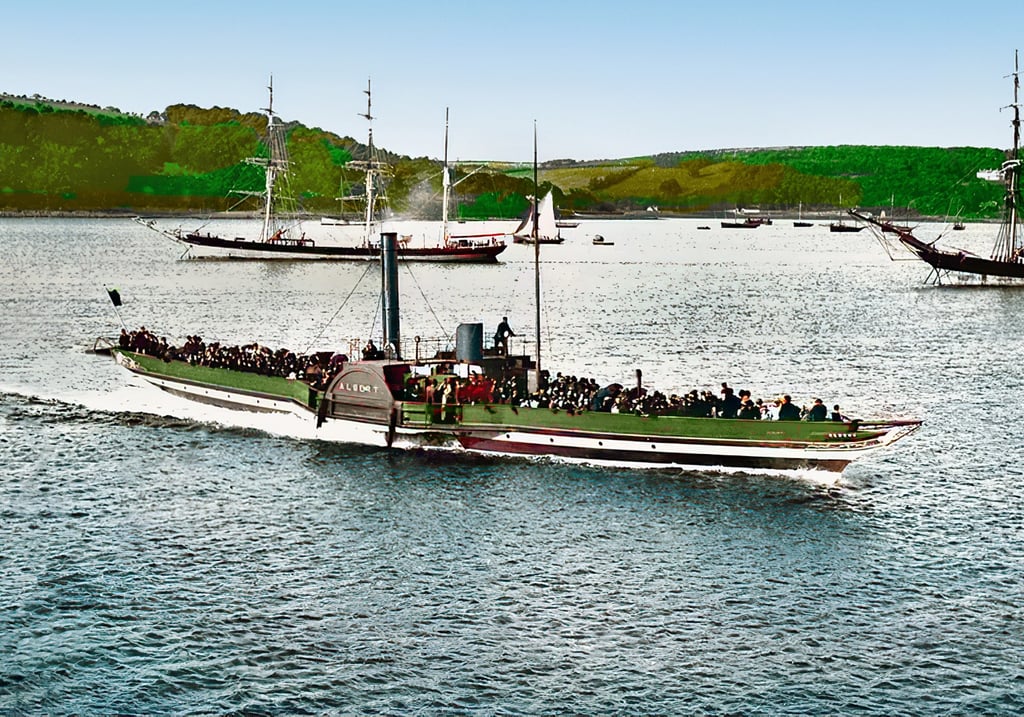
The passenger steamer 'PS Albert' was built for the Cork, Blackrock and Passage Railway Company in 1881. One hundred and forty feet in length, she was able to accommodate 460 passengers. The kcompany also had three other steamers - the Victoria, the Fairy and the Queenstown. These steamers came to be known as the 'Green Boats' because of their distinctive livery.
The Cork, Blackrock and Passage Railway Company, having completed the railway, immediately set about the creation of a new steamboat service to link up with it. Their steamers later came to be known as the 'Green Boats'.
On Sunday 13 July 1851 the C.B. & P.R.'s first steamer, Queenstown, built by Mare and Co. of London went into service between Passage , Monkstown and Queenstown. Three more steamers were purchased during the next few years - the Victoria in June 1852, the Fairy in June 1953, and the arrival of the Albert in August 1854 completed the delivery. The services provided by these steamers extended to Aghada and other harbour locations. The boats were now quite sizeable. The 'Victoria' for instance, was 134 ft long; beam 15.1 ft,; depth 7.6 ft; tonnage 82; two cylinders, 29" x 33" stroke-developing 50 H.P.
Eventually a 'station master' was employed at Aghada, a waiting room was built, and in 1890 the company selected Aghada as thelocation for its goods store. Much of that original structure still stands where the garage and filling station operates on the pier, today.
The introduction of the Queenstown saw the beginning of serious rivalry between the steamers of the competing companies. This led to many accidents, including numerous collisions. There were three different steamboat companies now operating in the harbour. This led to open 'warfare' on the water as steamers raced each other to arrive first at the various piers. The first to arrive usually collected the passengers.
Of course not all the boats were serving the same destinations-Some served Cork City directly, while others linked up with the train service in Passage. By 1862, the Great Southern and Western Railway had completed its line direct from Cork to Cobh. As a consequence, it was now possible to travel by steamer to Cobh and from there by rail to Cork.
The River Steamers Co. responded to the competition provided by the C.B. and P.R. by reducing fares by over 45%. The latter company lowered their fares from an average of 5d to less than 4d. They also introduced a third class carriage on their trains for the 'labouring classes'. Now, for 2d, one could journey in an open carriage which accommodated 70 passengers with 'neither seats nor divisions.'
The only ones to benifit, from all this, were the public and in November 1851 the rivals were called upon to come to "fair terms, equally favourable to the public and themselves". The call went unheeded and the competition, if anything, escalated.
In May 1853, a further steamer service was put in place, by the C.B. & P.R., linking with Ballinacurra. When the Cork to Youghal railway, which passed through Midleton, was opened in 1859 this steamer service to Ballinacurra was put under pressure. As a counter measure the C.B. and P.R. Directors, in 1861, arranged for a bus to run from the centre of Midleton to Ballinacurra, with a ferry connection to Passage. This long and tedious journey, involving at least two changes, was derided by the opposition, who said that the "people of East Cork and Midleton would sooner travel to Cork City on a jingle" (a horse-drawn, two wheeled covered vehicle, indigenous to Munster).
The level of competition was now hurting the C.B. and P.R. Though passenger numbers remained high, rail fares 30% below corresponding English lines, rendered profits almost impossible. The River Steamer's Co., sensing victory in the fares war introduced further reductions in 1855. "Hate fares", as low as 2d, became the order of the day. Acknowledging that this sort of competition could not continue, representatives of each company met in May 1856. Subsequently an 'arrangement' between them was announced which by 1860 amounted to a monopoly on the river.
Through the early part of the century, until the war broke out in 1914 the service continued to prosper though steamer sailings were reduced in order to achieve savings. Shortly after the outbreak of war civilian activity was curtailed in and around Crosshaven, because of the proximity of Fort Camden. Unauthorised visitors were forbidden to disembark from trains or steamers. This military curfew took its toll and it took an award of £21,630 in government compensation to keep the service afloat.
In 1917 and 1918 restrictions were eased, and with the harbour dockyards and other military bases experiencing a boom, services improved once again. A military order and curfew of 17 June 1921 halted rail and steamer services during the peak season. This major setback was a response to I.R.A, seizures of mail and military stores during the War of Independence. The restrictions lasted until the truce in July '21. An attempt to re-establish the steamer goods service a month later was foiled by a railway strike - the first railway workers' strike in the history of the C.B.&P.R. On 10 February 1922, the railway terminus was occupied by 100 strikers who planned to run a limited service as 'co-operative railway workers'.
Just seven months after the service resumed in Aug. 1922 services again ceased when Republican Forces demolished the Douglas viaduct in an attempt to delay the Free State advance on Cork. Alternative transport was provided in the harbour when a second steamer, Hibernia, joined the Albert. The affects of the Civil War were disastrous for the C.B & P.R. Signal boxes were burnt down and Carrigaline bridge was wrecked. By the end of 1923 these viaducts and bridges were repaired sufficiently to get the trains moving again.
By August 1924 the Provisional Government amalgamated many of the smaller railway companies. The C.B. & P.R. was now absorbed into the newly formed Great Southern Railway Company, and so the popular little line, which had carried thousands of tourists to riverside resorts, and traversed the waters of Cork harbour for 74 years, came to an end. Shortly after taking over the service the new company set about disposing of the three remaining steamers, 'Queenstown', 'Albert' and Rostellan. In fact, the vessels were rather old at this stage and the steamer service was losing money.
The Great Southern Railway maintained an ever failing battle against road transport before finally giving way to the motor car in September 1932. In spite of petitions to keep it open, the last train puffed down the permanent way on 10 September 1932. It had been losing £4,000 per annum. The railway and steamer services, arguably the most picturesque in Europe, had finally surrendered to the onward march of time.