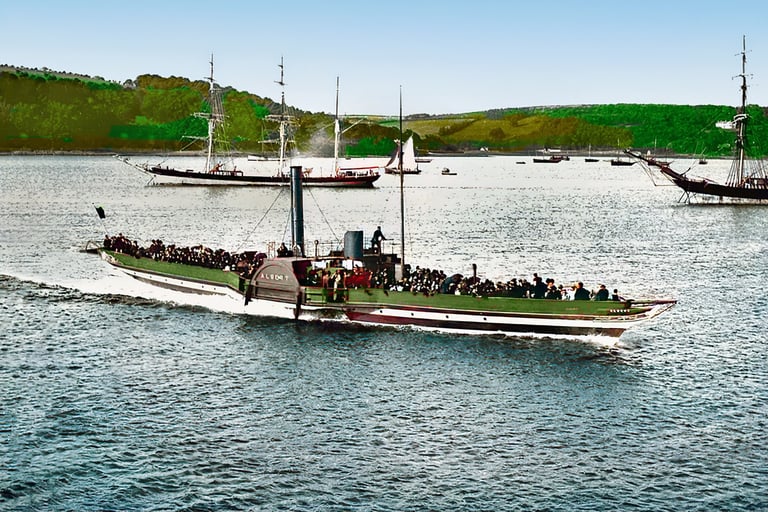
Cork Harbour, in the 19th century, was a high-tech laboratory for the burgeoning steam industry. Because the city of Cork was located several miles up the narrow River Lee, steam power became the "disruptor" that allowed for reliable, scheduled transport regardless of the wind.
The "River Steamers"
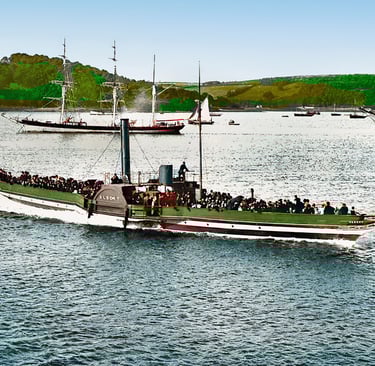
The 19th-century commute - Long before the "Cork-Blackrock-Passage" railway dominated, the harbour was alive with a fleet of Paddle Steamers. These were the primary mode of transport for commuters and day-trippers.
The Routes: Steamers ran from St. Patrick’s Quay in the city down to Passage West, Monkstown, Glenbrook, and Queenstown (now Cobh).
The Experience: They were known for their distinct "clatter" and the huge plumes of black smoke. For the wealthy merchants of Cork, these ships were their "water taxis" to their summer villas in the lower harbour.
Famous Vessels: Names like the City of Cork, the Albert, and the Nelson were household names.
The City of Cork Steam Packet Company - Established in the 1820s, this company became the backbone of Cork’s maritime economy. They didn't just move people; they moved the "Butter Trade."
The Livestock Trade: Their ships were specifically designed to carry cattle, pigs, and the famous Cork butter to Bristol, Liverpool, and London.
The House Flag: Their "white star on a blue background" flag was a constant sight in the harbour for over a century. Many of their steamers were requisitioned during WWI and WWII, with several lost to U-boat activity in the Celtic Sea.
The Transition: Paddle to Screw
As technology evolved at the Passage West and Rushbrooke docks, you could see the physical transformation of the ships:
Early Steamers (1820s-1850s) Later Steamers (1860s+)
Propulsion - Large side-mounted Paddle Wheels to rear-mounted Screw Propellers.
The hull material was primarily wood and iron, then steel
The Great Liners (The "Age of the Giants")
By the late 1800s and early 1900s, Cork Harbour (Queenstown) became the final port of call for the most famous steamships in history. While these weren't "Cork ships" per se, they defined the harbour's atmosphere.
The White Star & Cunard Lines: Ships like the Olympic, the Mauretania, and most infamously, the RMS Titanic, used the harbour as their last stop before the open ocean.
The Tenders: Because these giants were too large for the quays, local Cork-based steam "tenders" (like the PS America and PS Ireland) would ferry passengers and mail from the Cobh deep-water quay out to the liners anchored at Rochester Point.
The era of the great steamships eventually faded with the rise of the internal combustion engine and air travel, but the limestone quays of Cork Harbour still bear the marks of the heavy chains and bollards that once held these smoke-belching giants in place.
To understand the steamships of Cork Harbour, you have to look at them as "mechanical beasts" that carried the weight of human hope and desperation. The engineering wasn't just about speed; it was the very thing that transformed a death-defying two-month sail into a predictable two-week commute.
Early steam engineering in Cork was a battle against the sea and salt. The transition from the 1830s to the 1900s saw a massive leap in how power was generated and used.
1. The Side-Lever Engine - The SS Sirius used a Side-Lever Engine. Imagine a giant rocking horse made of iron. Because early boilers were top-heavy, the heavy machinery was placed as low as possible in the hull to keep the ship stable.
The Coal Problem: These early engines were incredibly inefficient. They burned through coal so fast that ships often ran out mid-Atlantic (hence the Sirius burning its own furniture!).
2. The Surface Condenser Breakthrough - A major local innovation involved the Surface Condenser, pioneered by Samuel Hall and used in Cork-bound ships.
Why it mattered: Before this, boilers used seawater. The salt would crust up the pipes (scaling), causing them to overheat and explode. The surface condenser allowed ships to reuse fresh water, making long-distance steam travel safe.
Triple Expansion 1880s - The "Workhorse" of the Victorian age. Extremely reliable and powerful.
You can't talk about Cork steamships without starting with the SS Sirius.
In 1838, under the command of Captain Richard Roberts (a Passage West native), the Sirius became the first vessel to cross the Atlantic from East to West entirely under steam power.
It was a close-shave victory. The ship was actually quite small for the journey, and legend has it they had to burn cabin furniture and spare yards to keep the boilers going as they neared New York, arriving just hours before the much larger Great Western. It proved that transatlantic steam travel was commercially viable, turning Cork into a primary "gateway" to the New World.
The Social History: Hope, Heartbreak, and Class
The social fabric of Cork Harbour was torn and re-sewn by these ships. The harbour wasn't just a place of work; it was a place of "The Last Goodbye."
For the millions of Irish emigrants leaving through Queenstown (Cobh), the arrival of a steamship was bittersweet.
Families held "American Wakes"—parties for the living who were treated as if they were dying, because they would likely never be seen again.
The Steam Tenders (smaller boats like the PS America) would ferry these families from the pier to the giant liners. The sound of the steam whistle was often described in local lore as a mournful "wail" that signaled the final separation.
2. Life Below Deck: The "Black Gang"
While wealthy passengers in the grand saloon enjoyed mahogany panels and velvet, the "social history" of the ship's bowels was much darker.
The Stokers: Known as the "Black Gang," these men worked in 100°F+ temperatures, shoveling tons of coal into the furnaces.
In Cork, being a "Coal Heaver" was a grueling but vital job. The local economy in Passage West and Cobh relied entirely on the physical strength of these men to keep the "beasts" fed.
3. The "Steerage" Experience
Steamships shortened the journey, which ironically saved lives. On sailing ships ("Casket Ships"), disease ran rampant due to the long duration. Steamers were crowded and smelled of oil, coal smoke, and sea sickness, but their speed meant that passengers were less likely to starve or die of typhus before hitting New York.
"The steamship didn't just carry people; it carried the future. To the person in steerage, the engine's vibration was the heartbeat of a new life in America."